Students in government and aided schools who cleared their state’s means-cum-merit test have been given one more month. The Ministry of Education has moved the National Scholarship Portal (NSP) deadline for the NMMS scholarship 2026-27 to 31 October 2026, All India Radio reported on 1 October. This is the second extension of the season. At the start of September the window had already been stretched to 30 September.
The money is modest but it is steady. An awardee gets ₹12,000 a year, credited straight to a bank account, from Class 9 right through Class 12, provided the child keeps meeting the renewal conditions. For a family earning less than ₹3.5 lakh a year, that pays for guidebooks, a bus pass or tuition in a board year. This report sets out who qualifies, how the state test works, the difference between a fresh and a renewal application, and the exact order of steps on NSP. Official links are at the end.
NMMS Scholarship 2026-27 Deadline: What Changed on 1 October
According to the AIR report, students now have until 31 October 2026 to submit applications on NSP. Verification dates have moved too. The Institute Nodal Officer (INO), who is the Level 1 verifier at the school, must clear applications by 15 November 2026. The District Nodal Officer (DNO), at Level 2, has until 30 November 2026. By the day before the announcement, more than 88,000 fresh and over 1.97 lakh renewal applications had been filed.
A month earlier, on 1 September, AIR had reported an extension to 30 September, with INO verification due by 15 October and DNO verification by 31 October. Every one of those dates has now slipped by a month. NSP itself opened for the 2026-27 academic year on 1 June 2026, so the full application window now runs for five months.
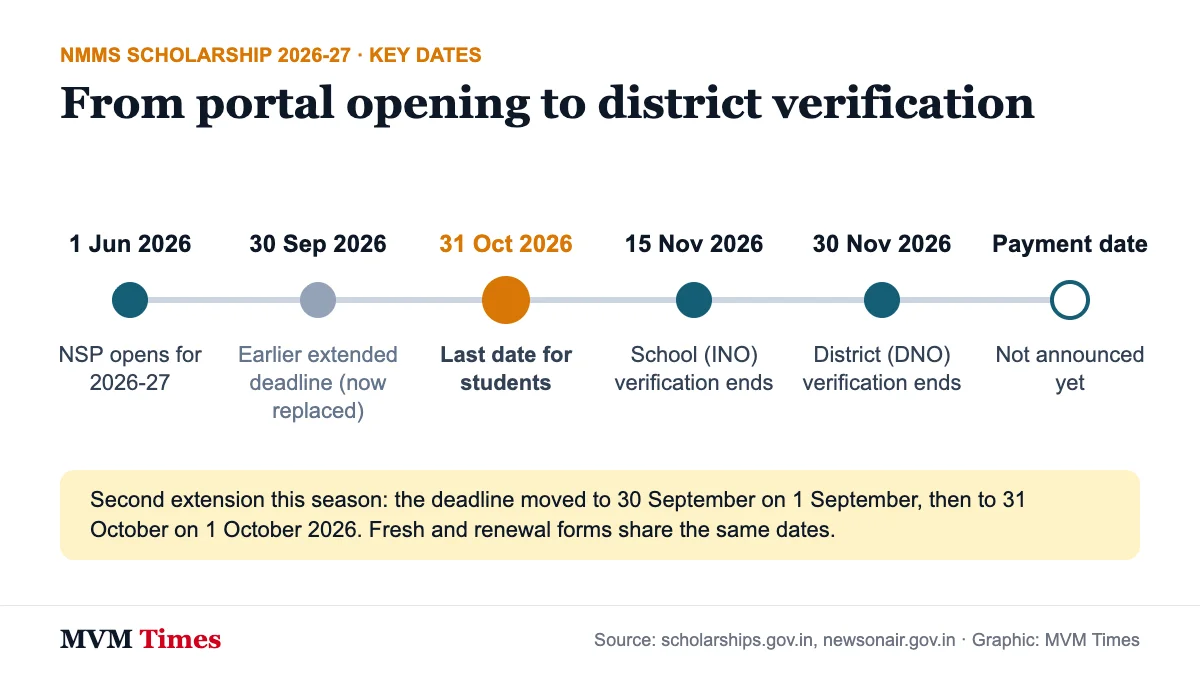
Last year followed a very similar pattern. A Ministry of Education note shared through PIB showed that NSP opened on 2 June 2025 and the deadline was later pushed to 30 September 2025, with Level 1 and Level 2 verification closing on 15 and 31 October 2025. On 30 August 2025 the count stood at 85,420 fresh and 1,72,027 renewal applications. In both years, fresh applications at those points were well below the one lakh new scholarships the scheme offers every year.
What the Scheme Pays and Who Runs It
The National Means-cum-Merit Scholarship Scheme (NMMSS) is run by the Department of School Education and Literacy in the Ministry of Education. Its stated aim is to stop bright children from poorer homes dropping out after Class 8. Each year, one lakh fresh scholarships are shared out among the states and Union Territories as fixed quotas. According to the scheme guidelines, two-thirds of each quota is based on Class 7 and 8 enrolment and the remaining third on the state’s child population in that age group.
The award is ₹12,000 a year, which works out to ₹1,000 a month. It can run for up to four years, from Class 9 to Class 12. Payment goes through Direct Benefit Transfer, routed via the Public Financial Management System (PFMS). The guidelines prefer that the account be with SBI, another public sector bank or a scheduled bank on core banking. A student can draw only one central government scholarship at a time, so a child already holding another central award will have to choose between the two.
Eligibility for NMMS Scholarship 2026-27
There are two sets of rules. The first decides who can sit the state selection test. The second decides who gets the award after the result. The table below combines both, as they appear in the ministry guidelines and in the 2026 AIR reports.
| Condition | What the rules say |
|---|---|
| Class | Regular student in Class 8 at the time of the test; the scholarship starts in Class 9 |
| School type | Government, government-aided or local body school |
| Schools not covered | Kendriya Vidyalayas, Jawahar Navodaya Vidyalayas, state or central government residential schools that provide boarding and lodging, and private schools |
| Family income | Parental income from all sources not above ₹3,50,000 a year |
| Class 7 marks (to sit the test) | At least 55% or an equivalent grade; 50% for SC/ST students |
| Class 8 marks (at selection) | At least 55% or equivalent; 50% for SC/ST students |
| Selection test | At least 40% in MAT and SAT taken together; 32% for SC/ST students |
| Reservation | As per the reservation norms of the state or UT |
| Other central scholarships | Only one central scholarship can be held at a time |
Clearing the cut-off does not by itself guarantee the money. Awards are made in merit order within the state quota and after applying the state’s reservation rules. In a state with many candidates, the marks needed to make the list can sit well above 40%.
A Note for Private School Families, Including MVM
Because the guidelines exclude private schools, students of privately run, fee-charging schools are not covered. That includes the Maharishi Vidya Mandir branches across the country. Parents comparing the cost of a private CBSE school with a government school can see current charges on our MVM fees structure page. The same exclusion applies to Kendriya Vidyalayas and Navodaya Vidyalayas, even though both are run by the government.
The State Selection Test: MAT and SAT
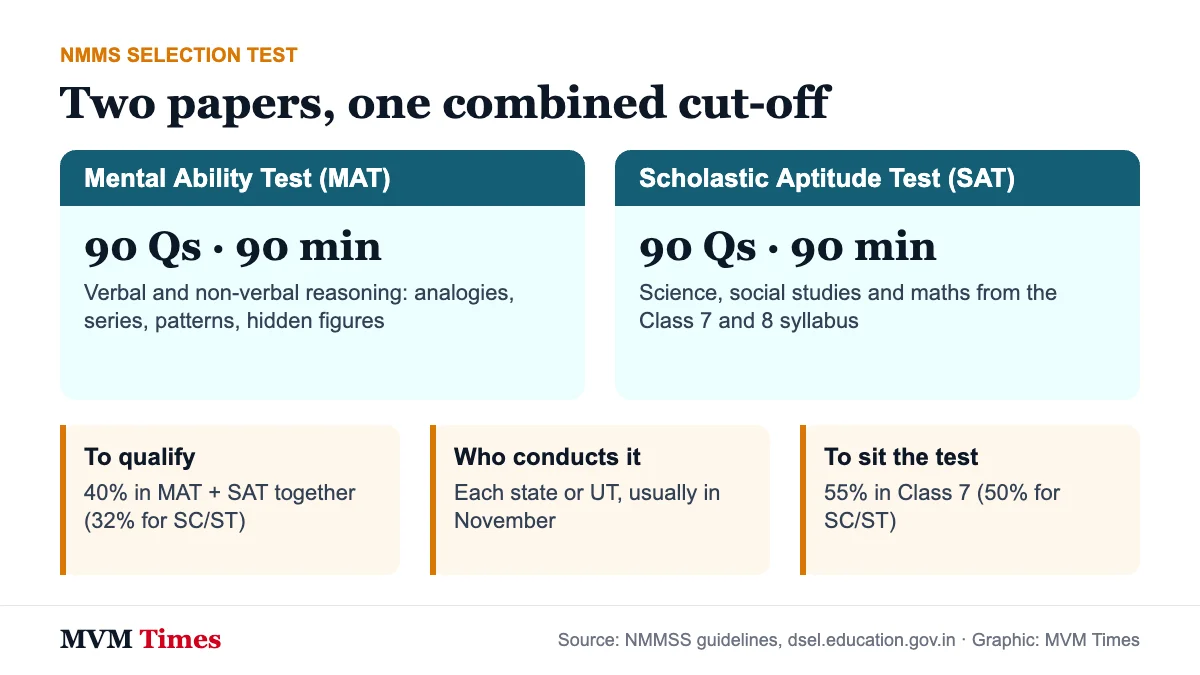
The Centre does not hold a national exam for NMMSS. Clause 2.1 of the guidelines says that each state and UT conducts its own test at the Class 8 stage, and Clause 7.0 states that the test is normally held in November every year. The state’s chosen agency sets the paper, publishes the result and draws up the selection list against its quota. Students who sat the state test in the 2025-26 session and made that list are the ones now filing fresh applications for 2026-27.
Mental Ability Test (MAT)
This part has 90 multiple-choice questions on verbal and non-verbal reasoning. Expect analogies, classification, number series, pattern perception and hidden figures. Students get 90 minutes, and children with disabilities are allowed extra time.
Scholastic Aptitude Test (SAT)
This part also has 90 questions in 90 minutes. They are drawn from science, social studies and mathematics as taught in Classes 7 and 8, so it closely follows the state school syllabus. The qualifying mark is 40% across both papers combined, or 32% for SC and ST students.
Dates for the next round, which will feed the 2027-28 awards, are announced separately by each state. No central calendar has been published. Class 8 students who want to sit the test should ask their school head or watch the state education department’s website for the notice.
Fresh Application or Renewal: Which One Are You?
A fresh application is for a student who made the state selection list and is now in Class 9 in 2026-27. A renewal is for someone who already holds the award and has moved up to Class 10, 11 or 12. Both go through NSP, both carry the same 31 October deadline, and both need school and district verification. Renewal is not automatic. The guidelines state that the scholarship stops if the renewal is not completed on the portal within the time allowed.
Renewal Conditions
- Clear promotion from Class 9 to Class 10 in the first attempt.
- At least 60% marks in the Class 10 examination to carry the award into Class 11, relaxed by 5% for SC and ST students.
- Clear promotion from Class 11 to Class 12 in the first attempt.
- A break of one full academic session ends the scholarship, and it cannot be revived later.
The Class 10 condition catches the most students. A child currently in Class 10 on the award will have to score 60% in the 2027 board exam to keep getting money in Class 11. Students write whichever board exam their school follows. For aided schools affiliated to national boards, the CBSE 10th date sheet 2027, the CBSE 12th date sheet 2027 and the ICSE 10th time table 2027 are tracked on this site.
How to Apply for NMMS Scholarship 2026-27 on NSP
Since the 2024-25 session, NSP has required a One Time Registration (OTR) before any scholarship form can be filled. The OTR is a 14-digit number generated from the student’s Aadhaar or Aadhaar Enrolment ID (EID). It stays the same for the student’s whole academic career, so a renewal applicant who made one last year does not need a new one. The order of steps is as follows.
- Go to scholarships.gov.in or install the NSP OTR app from the Google Play Store. Generate your OTR using Aadhaar or the Aadhaar Enrolment ID. Parents can do this on behalf of a minor.
- Complete face authentication in the NSP OTR app. If you get error 904, update the UIDAI AadhaarFaceRD app. Also check, through mAadhaar or the My Aadhaar portal, that the Aadhaar biometric lock is set to “Unlocked”.
- Log in to NSP with your OTR number and open the “Apply for Scholarship” section. Pick the National Means-cum-Merit Scholarship from the schemes shown for your profile. Renewal students choose the renewal option.
- Enter school, academic, income and bank details carefully. The school must be the same one where your Institute Nodal Officer will verify the form.
- Upload the documents your state asks for, check every field, and submit before 31 October 2026. Save or print the acknowledgement.
- Tell your school that the form is submitted. The INO has to verify it by 15 November, after which it moves to the District Nodal Officer, who has until 30 November.
If there is no smartphone or computer at home, Common Service Centres (CSCs) can handle OTR generation, biometric authentication and the full application. NSP lists a fixed fee of ₹30 per candidate for this. Students with disabilities must first log in to the UDID portal and give consent to share their details before they apply.
Documents to Keep Ready
NSP asks for scanned copies, and the exact list can differ slightly from state to state. Keep the following ready. Ask the INO before uploading in case your state needs anything extra.
- Aadhaar card, or the Aadhaar Enrolment ID slip if the Aadhaar card has not been issued yet
- Income certificate from the competent authority showing parental income up to ₹3.5 lakh a year (upload a clear, readable scan)
- Bank passbook first page showing the student’s name, account number and IFSC
- Caste certificate for SC, ST or other reserved categories, where it applies
- Previous class marksheet, and a certificate from the head of the institution where the state requires one
- UDID details for students with disabilities
Institute and District Verification
Submitting the form is only the first step. Under the guidelines, the state government or UT administration verifies every application on NSP before the final list goes to the ministry for funds to be sanctioned. In practice, this happens in two stages: the school’s Institute Nodal Officer first, then the District Nodal Officer.
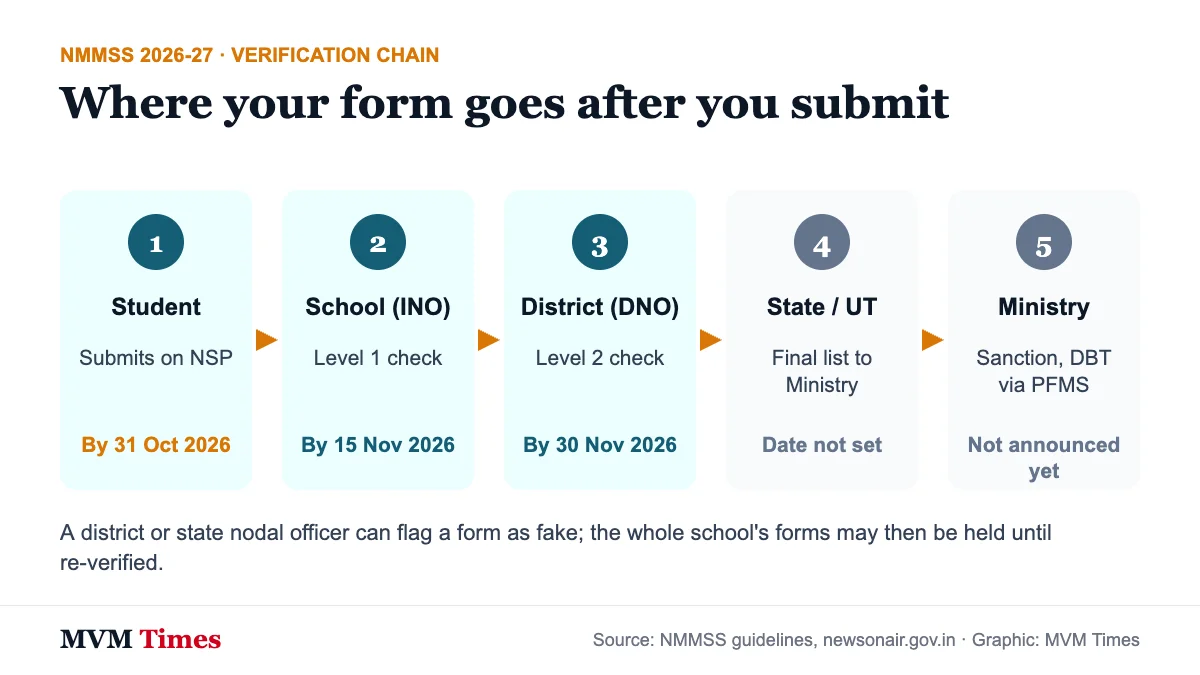
The guidelines make the school accountable. The INO must be a permanent member of staff, and the principal is responsible for supervising that role. District and state nodal officers can mark an application as fake. When that happens, all applications from that institution can be put on hold until they are re-verified, so one careless entry can delay classmates as well.
Why NMMS Applications Get Stuck or Rejected
The ministry does not publish a list of rejection codes for NMMSS. The problems below follow directly from the scheme rules, and they are the ones worth checking before you press submit.
- Income above the limit, or an income certificate that does not clearly show the annual figure.
- Wrong school category. A student who has moved to a private school, a KV, a JNV or a residential government school is outside the scheme.
- Name not on the state selection list. Clearing 40% in MAT and SAT is not enough if the student fell outside the merit list for the quota.
- Renewal conditions not met, such as failing to get promoted in the first attempt or scoring below 60% in Class 10 (55% for SC/ST).
- Another central scholarship already being drawn in the same year.
- Verification missed because the school or district did not act before 15 or 30 November.
- Bank details that do not match the student’s name, or an account that is inactive, which holds up the DBT payment even after approval.
What Has Not Been Announced Yet
- Payment date for 2026-27: not announced. Money is released after verification and sanction, through PFMS.
- Any extension beyond 31 October 2026: none announced so far. Treat 31 October as final.
- State selection test dates for the 2027-28 cycle: announced by each state separately. There is no central schedule.
- Final count of fresh and renewal applications for 2026-27: not yet published.
We will update this page if the ministry issues a fresh notice. Other school scholarship and exam updates appear in our education news section, and board timetables are listed under board exams.
NMMS Questions Parents Often Ask
What is the last date to apply for the NMMS scholarship 2026-27?
Students can submit on NSP until 31 October 2026. School-level verification closes on 15 November and district-level verification on 30 November 2026, as reported by All India Radio on 1 October.
How much money does an NMMS scholar get?
₹12,000 a year, or ₹1,000 a month, paid by Direct Benefit Transfer into the student’s bank account. It can continue for four years, from Class 9 to Class 12, if the renewal conditions are met.
Can a student from a private school or a Kendriya Vidyalaya apply?
No. The guidelines limit the scheme to government, government-aided and local body schools. Private schools, Kendriya Vidyalayas, Jawahar Navodaya Vidyalayas and residential government schools with boarding are excluded.
Who conducts the NMMS exam?
Each state or Union Territory conducts its own selection test for Class 8 students, normally in November. There is no single national exam. The test has two papers, MAT and SAT, with 90 questions each.
I got the scholarship last year. Do I need a new OTR?
No. The OTR number is valid for your whole academic career. Log in with your existing OTR and file the renewal application before 31 October 2026.
Families still unsure about any field should sit with the school’s nodal officer well before 31 October, so that any mistake can still be corrected in time.
Official Links: NMMS Scholarship
| What it is | Official link |
|---|---|
| National Scholarship Portal (apply, OTR) | scholarships.gov.in |
| NMMSS scheme guidelines (Ministry of Education) | dsel.education.gov.in |
| AIR report: deadline extended to 31 October 2026 | newsonair.gov.in |
| AIR report: earlier extension to 30 September 2026 | newsonair.gov.in |
| Ministry note on NMMSS 2025-26 (PIB) | dsel.education.gov.in |