
The Kisan Credit Card (KCC) is the main way farmers in India get short-term bank credit for crops and allied work. A single card gives a revolving limit that can be drawn and repaid during the season, at a concessional interest rate if repaid on time. According to a PIB backgrounder released on 11 March 2026, more than 7.72 crore KCC accounts are active, with about Rs 10.2 lakh crore of credit outstanding.
This guide covers the current loan limits, interest rate, eligibility, documents and the application process, based on official government information.
- Scheme: Kisan Credit Card (introduced in 1998; revised in 2020)
- Interest: 7% on short-term crop loans up to Rs 3 lakh; 4% effective with 3% subvention for prompt repayment
- Loan limit under MISS: Raised from Rs 3 lakh to Rs 5 lakh (announced for 2025-26)
- Collateral-free limit: Rs 2 lakh per borrower (from 1 January 2025)
- Validity: Revolving credit for up to 5 years
- Where to apply: Commercial banks, regional rural banks and cooperative banks
What Is the Kisan Credit Card Scheme?
KCC was introduced in 1998 to give farmers timely and affordable credit from banks instead of moneylenders. Over the years it has been extended from crop loans to animal husbandry and, from 2018-19, to fishers and fish farmers. The Revised KCC Scheme of 2020 added a RuPay-enabled card for cash withdrawals and digital payments, with one-time documentation.
The interest benefit comes through the Modified Interest Subvention Scheme (MISS), under which the central government compensates banks so that farmers pay a lower rate. Banks file their subvention and prompt repayment claims through the Kisan Rin Portal, launched in September 2023.
Kisan Credit Card Loan Limit 2026
The limit on your card is fixed by the bank based on your land, crops, the scale of finance for those crops in your district, and your repayment record. The key government-set figures are:
| Item | Limit |
|---|---|
| Loan limit under MISS (crop loans) | Raised from Rs 3 lakh to Rs 5 lakh |
| Fisheries and allied activities | Raised from Rs 2 lakh to Rs 5 lakh |
| Collateral-free credit | Up to Rs 2 lakh per borrower (raised from Rs 1.6 lakh from 1 January 2025) |
| Marginal farmers | Flexible limit of Rs 10,000 to Rs 50,000, based on land and cropping pattern |
These increases were announced for 2025-26. How much of a higher limit gets the interest benefit can vary, so ask your bank how your limit is split and what rate applies to each part.
Kisan Credit Card Interest Rate
| Particular | Rate |
|---|---|
| Interest on short-term agricultural loans up to Rs 3 lakh | 7% per annum |
| Additional subvention for prompt repayment | 3% |
| Effective rate for farmers who repay on time | 4% per annum |
To get the 4% rate you must repay within the due date set by the bank, which is usually linked to the harvest of the crop. Miss the date and you lose the extra 3% benefit for that loan. Loans above the subvention limit, and some term loans for investment, are charged at the bank’s own rate.
In case of natural calamities, the PIB backgrounder notes that no interest is charged for up to one year, and this can be extended up to five years in severe disasters, as per the relief norms.
Benefits of the Kisan Credit Card
- Cheaper credit: 4% effective interest on eligible short-term loans for prompt repayment.
- Revolving limit: withdraw and repay as needed within the sanctioned limit, without applying for a fresh loan every season.
- No collateral up to Rs 2 lakh: as per RBI norms, banks do not ask for security for loans up to this amount.
- RuPay card: withdraw cash at ATMs or pay digitally for seeds, fertiliser and other inputs.
- Allied activities covered: working capital for dairy, animal husbandry, poultry and fisheries.
- Long validity: the revolving facility runs for up to five years, subject to annual review.
Who Is Eligible for a Kisan Credit Card?
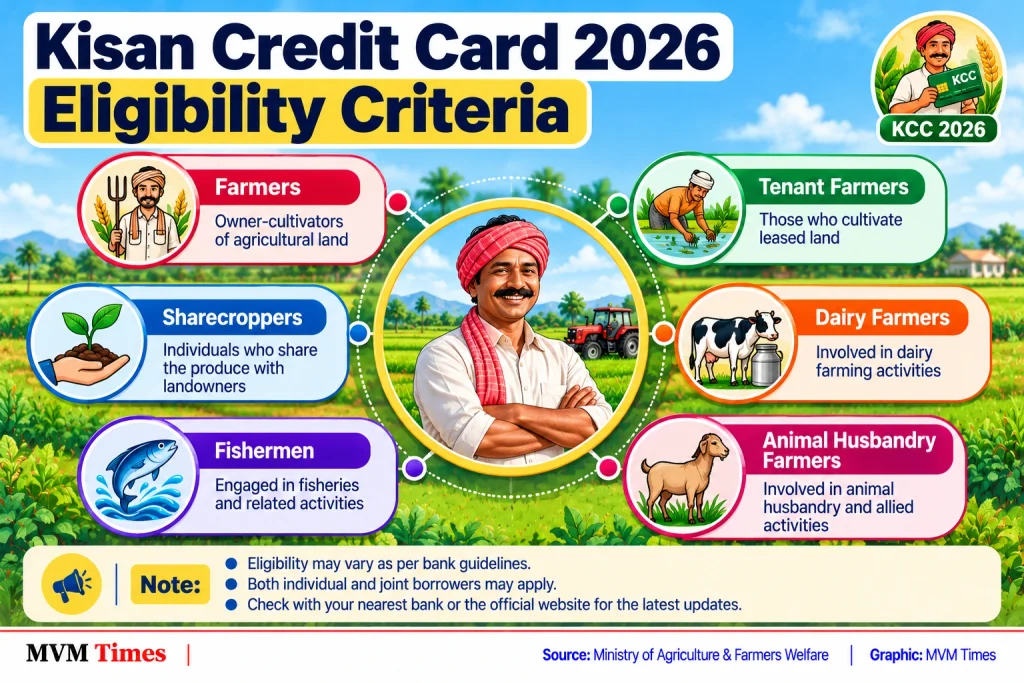
- Individual farmers and joint borrowers who are owner-cultivators
- Tenant farmers, oral lessees and sharecroppers
- Self Help Groups (SHGs) and Joint Liability Groups (JLGs) of farmers, including tenant farmers and sharecroppers
- Fishers and fish farmers, for working capital
- Farmers engaged in animal husbandry and dairy
Banks will check that you are actually cultivating land or running the allied activity. Tenant farmers and sharecroppers may be asked for a lease document or another proof of cultivation, depending on the state and bank.
Documents Required for KCC
Under the simplified process, the application is a one-page form, and basic details can be pre-filled from PM-KISAN records for PM-KISAN beneficiaries. Keep these ready:
- Filled KCC application form
- Copies of land records (or lease/cultivation proof for tenants and sharecroppers)
- Details of crops grown and area under cultivation
- Identity and address proof (such as Aadhaar) and a passport-size photo, for bank KYC
- Bank account details
Your bank may ask for more papers for higher limits or for allied activities.
How to Apply for a Kisan Credit Card
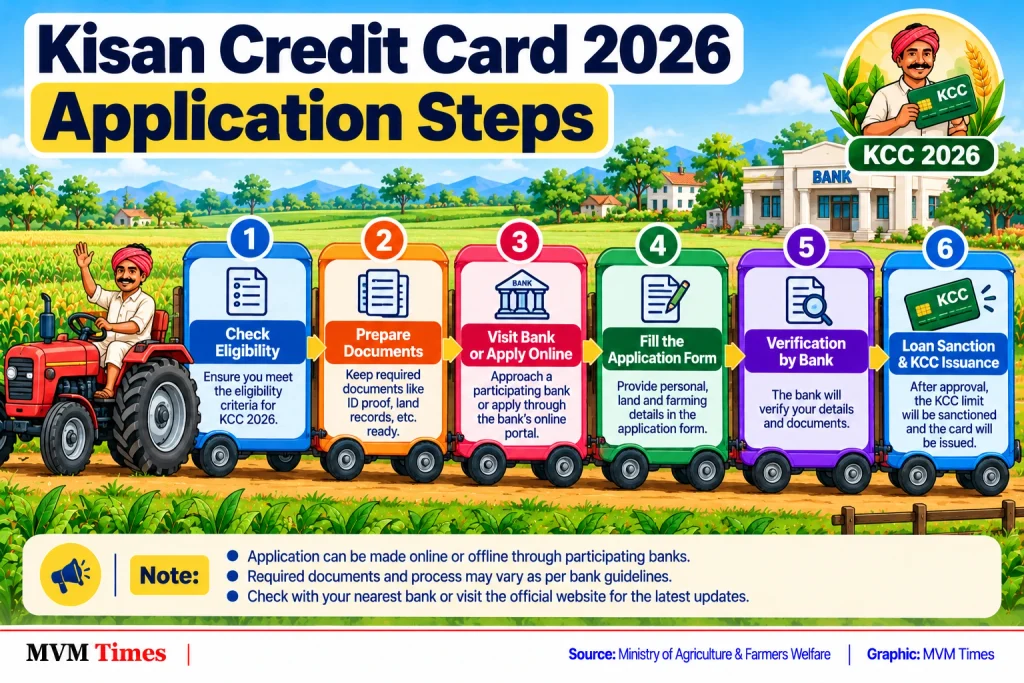
- Get the one-page KCC application form. It is available on the websites of scheduled commercial banks and on pmkisan.gov.in.
- Fill in your personal details, land details and crops.
- Attach copies of land records and KYC documents.
- Submit the form at a branch of a commercial bank, regional rural bank or cooperative bank, usually where you hold your account.
- The bank verifies the documents and land records, fixes your limit and issues the KCC.
You can also visit a Common Service Centre (CSC). The CSC operator can fill the form and send it digitally to the bank. Many banks also accept KCC applications through their own websites or mobile apps; check your bank’s site for this option.
Lending Institutions That Issue KCC
As per the PIB backgrounder, 457 banks are onboarded on the Kisan Rin Portal: 37 commercial banks, 46 regional rural banks and 374 cooperative banks. You can approach any of these for a KCC, though most farmers apply at the branch where they already bank.
KCC Validity and Repayment
The KCC limit is a revolving facility valid for up to five years, reviewed every year by the bank. Repayment of crop loans is linked to the harvest and marketing period of the crop for which the loan was taken. Repay on time each season to keep the 4% rate and a clean credit record, which also helps when the limit is reviewed.
What is the Kisan Credit Card?
It is a bank credit facility for farmers that gives a revolving limit for crop and allied activities, with a RuPay card for withdrawals and payments.
What is the KCC interest rate?
Short-term crop loans up to Rs 3 lakh carry 7% interest. With the 3% subvention for prompt repayment, the effective rate is 4%.
What is the maximum loan under KCC?
The loan limit under the Modified Interest Subvention Scheme was raised from Rs 3 lakh to Rs 5 lakh. Your actual limit is fixed by the bank.
Is collateral needed for a KCC?
No collateral is needed for loans up to Rs 2 lakh per borrower.
Can dairy farmers and fishers get a KCC?
Yes. KCC covers working capital for animal husbandry, dairy and fisheries.
How long is a KCC valid?
The revolving credit facility is valid for up to five years, subject to the bank’s annual review.
Official Links: Kisan Credit Card
| What it is | Official link |
|---|---|
| PIB backgrounder on KCC (11 March 2026) | pib.gov.in KCC backgrounder |
| PM-KISAN portal (KCC form) | pmkisan.gov.in |
| Kisan Rin Portal | fasalrin.gov.in |