Status checked 23 Oct 2026: Rules below are from CBSE’s 2026-27 curriculum, its Examination Bye-Laws and the 2026 exam notices. The 2027 date sheet and any fresh circular on pass criteria are still awaited.
Take a Class 10 student who gets 20 out of 20 in internal assessment and 13 out of 80 in the theory paper. Add the two and you get 33 out of 100. Is that a pass? Since CBSE put out its 2026-27 curriculum, this has become the most common question among parents and teachers about CBSE passing marks 2027, and the honest answer needs a little unpacking.
This guide puts the rules for Class 10 and Class 12 in one place: the 33 per cent rule, how theory, practical and internal marks are split in each main subject, how the board hands out A1 to E grades, why your marksheet carries no percentage, and what happens after a fail. Everything here comes from CBSE’s own documents and reports of its announcements, all linked. Where something has not been settled for 2027, we say that too.
- Pass mark: 33 per cent in each subject, Class 10 and Class 12
- Class 12 practical subjects: theory and practical have to be cleared separately
- Grades: nine-point positional grading, A1 to D2 for passed students; E means Essential Repeat
- No division or aggregate: CBSE does not award one or work out a percentage
- Second chance: Class 10 gets a second board exam in May; Class 12 gets one supplementary exam in July
- 2027 dates: not announced yet (as of 23 October 2026)
CBSE passing marks 2027 at a glance
Here are the CBSE passing marks 2027 rules side by side. Each row is explained further down.
| Rule | Class 10 (2027 exams) | Class 12 (2027 exams) |
|---|---|---|
| Minimum to pass a subject | 33 per cent | 33 per cent |
| Theory and practical/internal | Bye-laws ask for 33% in the subject; the 2026-27 curriculum wording says “separately” (see below) | 33% in theory and 33% in practical, separately, in subjects with practical work, plus 33% overall |
| Usual mark split | 80 board + 20 internal in all main subjects | 80/20, 70/30 or 60/40 depending on the subject |
| Grades | Nine-point positional grading | Nine-point positional grading |
| Division, distinction, aggregate | Not awarded | Not awarded |
| Second chance in the same year | Second board exam (May) | Supplementary exam (July) |
| Compartment allowed in | Up to two subjects | One subject |
Class 10: the 33 per cent rule, and the sentence that confused schools
Start with the rulebook. CBSE’s Examination Bye-Laws on pass criteria say a Class 10 candidate must get a grade higher than E, which means at least 33 per cent, in all five subjects of the external examination (clause 41.1). That clause does not ask for a separate pass in theory and internal assessment. Compare it with the Class 12 clause right above it, which spells out separate passing in theory and practical. For Class 10, the bye-law points to the subject total out of 100.
Then came the Secondary School Curriculum 2026-27 for Classes 9 and 10. In its chapter on the structure of assessment, it says a student must secure “a minimum of 33% marks separately in external and internal assessments”, and in the same sentence adds that this is worked out on the combined total of the two. Read one way, the theory paper and the 20 internal marks must each cross 33 per cent. Read the other way, nothing has changed. Both readings have been doing the rounds in staff rooms.
In the first week of October, several news and education websites reported that CBSE officials told schools, at the board’s 29 September 2026 webinar on registration and the List of Candidates, that the 2025-26 rule continues for the 2027 exams: 33 per cent on the combined total, with no separate pass in internal assessment. That may well be how things turn out. But the board’s own press note on that webinar lists the topics covered (student details, subjects, LOC data, fees) and says nothing on pass criteria, and we could not find a written circular on cbse.gov.in as of 23 October 2026. Until something is in writing, the cautious plan is to prepare as if both parts must be cleared on their own.
How many marks out of 80 does a Class 10 student need?
Thirty-three per cent of 80 is 26.4, so 27 is the first whole number that clears the theory paper on its own. Thirty-three per cent of 20 is 6.6, so internal assessment needs 7. Here is how the two readings compare for a few internal scores.
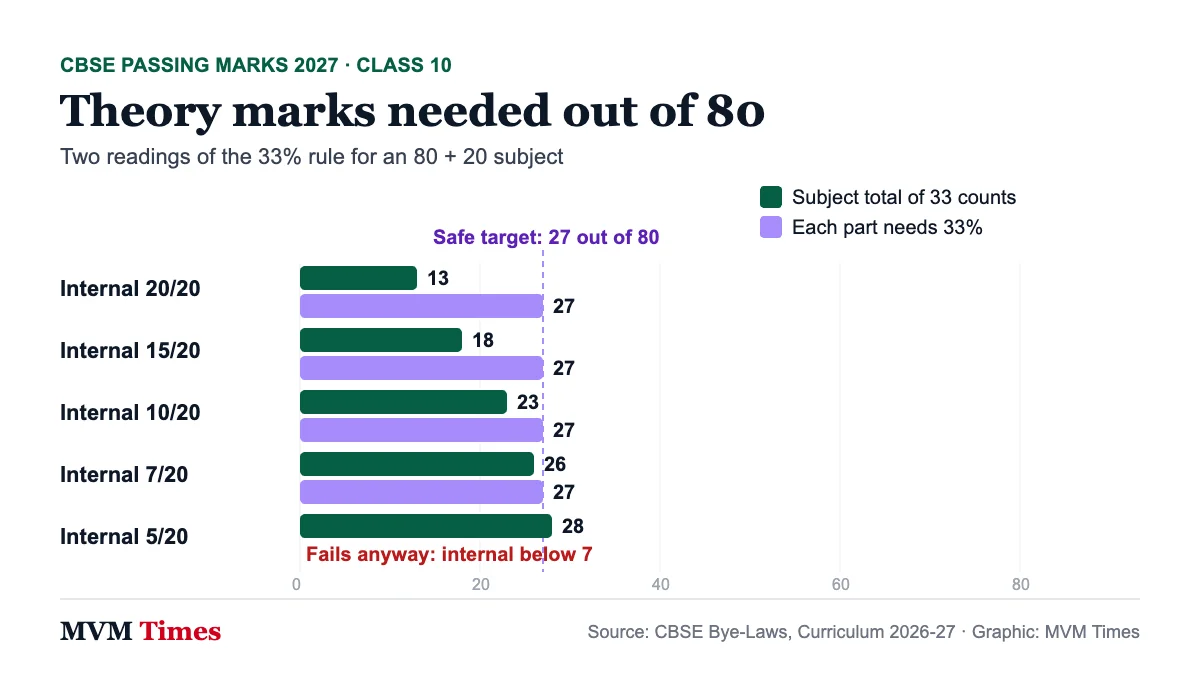
| Internal marks (out of 20) | Theory needed if only the total of 33 counts | Theory needed if each part must reach 33% |
|---|---|---|
| 20 | 13 out of 80 | 27 out of 80 |
| 15 | 18 out of 80 | 27 out of 80 |
| 10 | 23 out of 80 | 27 out of 80 |
| 7 | 26 out of 80 | 27 out of 80 |
| 5 | 28 out of 80 | Fails anyway: internal is below 7 |
Look at the last column. Under the stricter reading, a strong internal score no longer rescues a weak paper. A child who has been counting on 20 internal marks to carry a 13 in Mathematics is the one most at risk if the board applies the sentence literally. Twenty-seven out of 80 is the number to keep on the fridge.
Class 10 subject-wise marks for the 2027 board exam
Students writing the Class 10 board exam in 2027 stay on the existing scheme. The 2026-27 curriculum says so in plain words for Mathematics: Class 10 students of 2026-27 continue under the old pattern and may still opt for Mathematics Basic, as in 2025-26. Every main subject carries 80 marks in the board paper and 20 marks of internal assessment, with a three-hour paper. Skill subjects lean much more on internal and practical work.
| Subject | Board theory | Internal / practical | Total | Paper duration |
|---|---|---|---|---|
| Languages (Hindi, English, Sanskrit, regional and foreign languages) | 80 | 20 | 100 | 3 hours |
| Mathematics (Standard or Basic) | 80 | 20 | 100 | 3 hours |
| Science | 80 | 20 | 100 | 3 hours |
| Social Science | 80 | 20 | 100 | 3 hours |
| Home Science | 70 | 30 | 100 | 3 hours |
| National Cadet Corps (NCC) | 70 | 30 | 100 | 3 hours |
| Elements of Business or Elements of Book Keeping and Accountancy | 70 | 30 | 100 | 3 hours |
| Painting | 30 | 70 | 100 | 2 hours |
| Computer Applications, Information Technology, Artificial Intelligence | 50 | 50 | 100 | 2 hours |
| Retail, Introduction to Financial Markets, Introduction to Tourism, Beauty and Wellness, Front Office Operations, Marketing and Sales | 50 | 50 | 100 | 2 hours |
Two small print points from the same table. CBSE calls its list of optional subjects tentative and dated “as on March 2026”, so a school may not offer every one. And out of Computer Applications (165) and Information Technology (402), a student can take only one.
One more condition applies to this batch, and it has nothing to do with marks out of 100. The curriculum says students now in Class 10 under the old scheme must have studied three languages up to Class 8, and that no student will be allowed to appear in the Class 10 board exam unless he or she has passed the third language in the school’s internal assessment. A child who could not clear it in Class 8 is tested by the school at the end of Class 9 and gets one more chance in Class 10. If your child is in that group, check with the school now rather than in January.
The sixth subject is a real safety net
A Class 10 student who fails one of the three compulsory subjects, Science, Mathematics or Social Science, but passes the optional subject, gets the optional subject swapped in, and the result is worked out on that basis. The 2026-27 curriculum keeps this rule and ties it to the student having cleared the required languages. So the skill subject that many families treat as a free period can decide whether a child is declared pass. Ask the school which subject your child is registered for as the sixth one, and take its practical work seriously.
What changes for the batch now in Class 9
None of the following touches the 2027 exams, but parents with a younger child should know it is coming. For students who are in Class 9 in 2026-27 and will write the board exam in 2027-28:
- Mathematics Basic and Standard are being replaced by one common 80-mark paper, with optional Mathematics Advanced and Science Advanced papers of 25 marks and one hour each.
- A candidate who scores 50 per cent or more in an Advanced paper gets a line on the marksheet saying the Advanced Level has been cleared. Those marks are not added to the total.
- A third language (R3) is assessed entirely by the school, with no board paper, but clearing it is compulsory for the Class 10 pass certificate. A student who has not cleared R3 can still sit the board exams in other subjects.
CBSE passing marks 2027 for Class 12: theory and practical are cleared separately
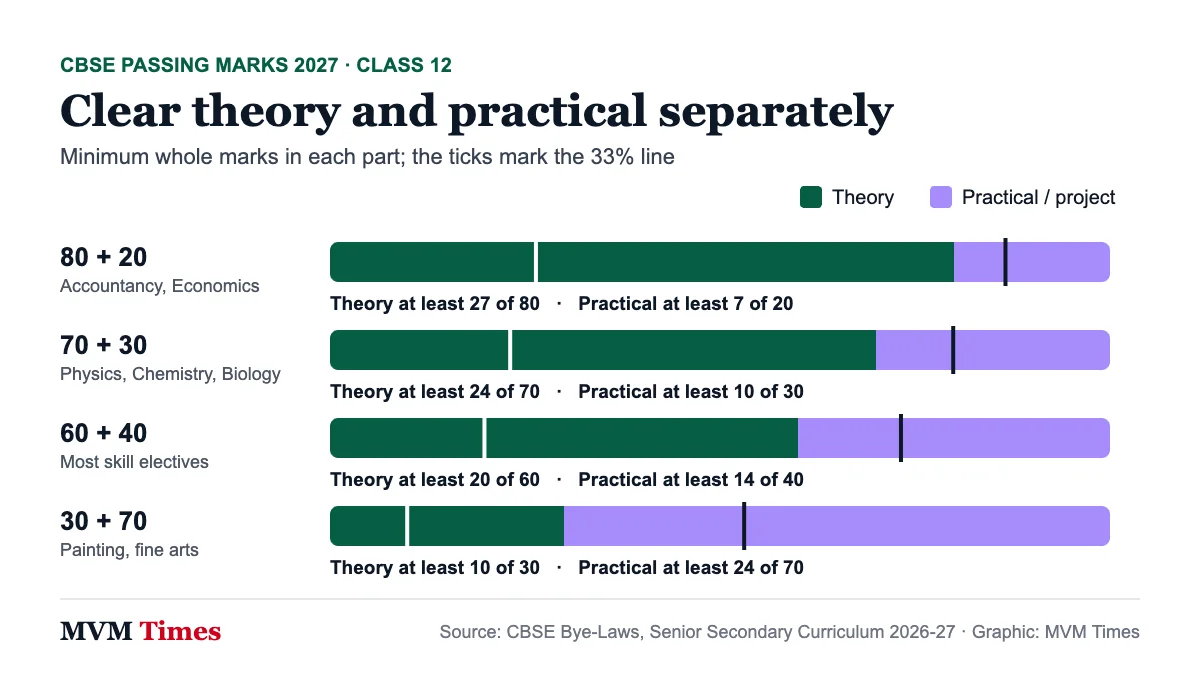
Class 12 has no grey area. Under clause 40.1 of the bye-laws, a candidate needs at least 33 per cent in each of the five external subjects, and in a subject with practical work, 33 per cent in theory and 33 per cent in practical separately, on top of 33 per cent in the subject as a whole.
This is where good students sometimes get caught. Picture a Physics candidate with 29 out of 30 in practicals and 21 out of 70 in theory. The total is 50 out of 100, which looks comfortable. It is still a fail, because 21 is below 33 per cent of 70. High practical marks cannot cover a weak theory paper in Class 12.
Class 12 subject-wise split in the 2026-27 curriculum
The Senior Secondary Curriculum 2026-27 lists the marks for every subject under three heads: theory, practical and internal assessment. These are the ones most students take.
| Subject (code) | Theory | Practical / project | Internal assessment |
|---|---|---|---|
| English Core (301), Hindi Core (302) | 80 | – | 20 |
| Mathematics (041), Applied Mathematics | 80 | – | 20 |
| Physics (042), Chemistry (043), Biology (044) | 70 | 30 | – |
| Computer Science (083), Informatics Practices (065) | 70 | 30 | – |
| Accountancy (055), Business Studies (054), Economics (030) | 80 | 20 | – |
| History (027), Political Science (028), Sociology (039), Legal Studies (074) | 80 | – | 20 |
| Geography (029), Psychology (037) | 70 | 30 | – |
| Physical Education (048), Home Science (064), Entrepreneurship (066) | 70 | 30 | – |
| Painting (049), Graphics, Sculpture, Applied/Commercial Art, classical dance | 30 | 70 | – |
| Most skill electives (codes 801 onwards, for example Information Technology 802) | 60 | 40 | – |
Accountancy, Business Studies and Economics show their 20 marks in the practical column of CBSE’s table, which in these subjects means project work. History, Political Science and Sociology show 20 marks as internal assessment instead. The separate-pass condition in the bye-laws is written for subjects involving practical work, so for an 80 plus 20 internal subject the clause asks for 33 per cent in the subject. If you want no risk at all, aim for 27 in the theory paper anyway.
Minimum marks for each paper pattern
| Paper pattern (theory + practical) | 33% of theory | 33% of practical | Whole marks to aim for |
|---|---|---|---|
| 80 + 20 | 26.4 | 6.6 | 27 and 7 |
| 70 + 30 | 23.1 | 9.9 | 24 and 10 |
| 60 + 40 | 19.8 | 13.2 | 20 and 14 |
| 30 + 70 | 9.9 | 23.1 | 10 and 24 |
CBSE’s curriculum does not spell out how it rounds a fraction like 23.1. We have rounded up to the next whole mark because 23 out of 70 is 32.9 per cent, just under the line. Treat 24 out of 70 as your floor in Physics, Chemistry, Biology or Computer Science and you will not have to depend on how the fraction is handled.
The sixth subject in Class 12
The first five subjects entered in the online registration, in that order, count as the main subjects. If a student has a sixth subject and fails one of the first five, the sixth replaces it, provided the combination still meets the scheme of studies, which in practice means English or Hindi must remain. Some subjects cannot sit together: Mathematics and Applied Mathematics, Business Studies and Business Administration, and only one of Computer Science, Informatics Practices and Information Technology.
CBSE grading system: how A1 to E grades are decided
CBSE’s grades are not fixed bands of marks. For both Class 10 and Class 12 board exams, the board ranks every candidate who has passed a subject, from the top score down, and cuts that list into eight equal slices. The top eighth gets A1, the next eighth A2, and so on down to D2. E is not a slice: it marks a candidate who has not passed, and the curriculum labels it Essential Repeat.
So an A1 in English and an A1 in Mathematics can sit at different marks, and the A1 cut-off in a subject can move from one year to the next. The grade tells you where a child stood among everyone who passed that paper in the country. The marks tell you how much of the paper they got right.
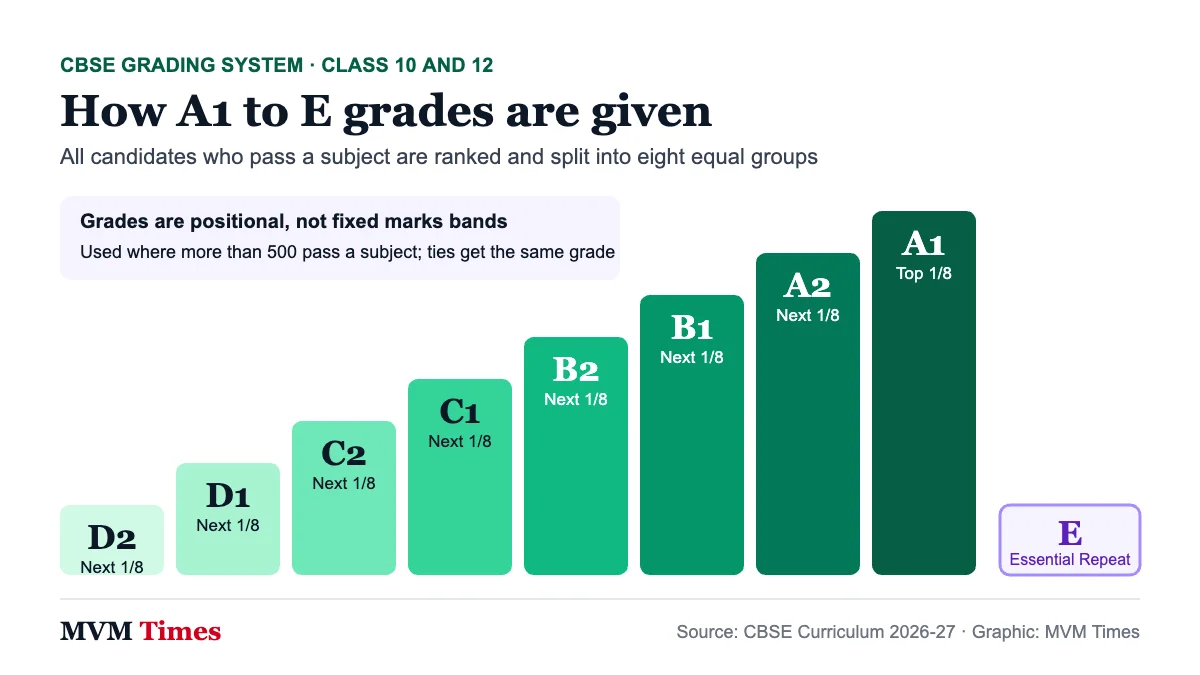
| Grade | Who gets it |
|---|---|
| A1 | Top one-eighth of passed candidates |
| A2 | Next one-eighth |
| B1 | Next one-eighth |
| B2 | Next one-eighth |
| C1 | Next one-eighth |
| C2 | Next one-eighth |
| D1 | Next one-eighth |
| D2 | Last one-eighth of passed candidates |
| E | Essential Repeat (not passed) |
The curriculum adds four working rules. Proportions shift slightly to handle ties. Everyone with the same score gets the same grade, and if a score point has to be split between two grades, the smaller group moves with the larger one. The method is used where more than 500 candidates pass a subject. Where fewer pass, the board copies the grade pattern of similar subjects.
Class 9 and Class 11 use fixed marks bands
School exams in Class 9 and Class 11 work differently. Because a single school has too few students for ranking to mean much, CBSE suggests absolute grading there.
| Marks | Grade |
|---|---|
| 91 to 100 | A1 |
| 81 to 90 | A2 |
| 71 to 80 | B1 |
| 61 to 70 | B2 |
| 51 to 60 | C1 |
| 41 to 50 | C2 |
| 33 to 40 | D |
| 32 and below | E (Essential Repeat), as listed for Class 11 |
Merit certificates for the top 0.1 per cent
Under clause 39 of the bye-laws, CBSE gives a Merit Certificate in each subject to the top 0.1 per cent of candidates who pass that subject, provided they meet the pass criteria. The number of certificates is worked out on the count of passed candidates rounded to the nearest thousand, no certificate is given in a subject with fewer than 500 passes, and if a cut-off score is shared, everyone on that score gets one.
No division, no aggregate: working out your own percentage
Clauses 40.1 and 41.1 of the bye-laws say it in one line each: no overall division, distinction or aggregate is awarded. The Class 12 curriculum repeats the point. The marksheet-cum-certificate shows marks in each subject separately, and no aggregate or percentage is printed. For students with six or seven subjects, it says the percentage is to be calculated by the norms of the college or institution where the student is seeking admission.
In practice, the formula belongs to whoever is admitting your child. A worked example shows why that matters. Say a Class 12 science student has these marks:
| Subject | Marks |
|---|---|
| English Core | 78 |
| Mathematics | 64 |
| Physics | 71 |
| Chemistry | 69 |
| Computer Science | 88 |
| Physical Education (sixth subject) | 92 |
- Average of the five main subjects: 78 + 64 + 71 + 69 + 88 = 370, divided by 5 = 74.0 per cent.
- Average of the best five: drop Mathematics (64) and add Physical Education (92): 78 + 71 + 69 + 88 + 92 = 398, divided by 5 = 79.6 per cent.
Same marksheet, a gap of 5.6 points. Because CBSE leaves it to the institution, one college may count the main five, another the best five, and another may look at particular subjects for a course. Read the admission notice before you quote a percentage anywhere. For Class 11 admission inside the same school, the stream cut-offs are also the school’s call; Maharishi Vidya Mandir branches, for example, admit to Class XI streams on the basis of the Class X board result, which we cover in our MVM syllabus and admission test guide and the MVM result and cut-off marks page.
If a student does not pass: second exam, supplementary and Essential Repeat
Class 10: the second board exam in May
CBSE approved two board exams a year for Class 10 on 25 June 2025, starting with 2026. As Business Standard reported at the time, the first exam is held in mid-February and is compulsory, with results in April; the second, in May, is optional, with results in June. Students can use it to improve in up to three subjects from Science, Mathematics, Social Science and languages. PTI’s report added that internal assessment is done only once in the session.
Two clarifications followed in February 2026, reported by News On AIR. Appearing in the first exam is mandatory. A student who misses three or more subjects in it cannot take the second exam, is placed in the Essential Repeat category, and can write those papers only in the next year’s February main exam. Students placed in compartment after the first exam can clear it in the second.
The first year gave a fair idea of how this plays out. The main exam ran from 17 February to 11 March 2026 and the second from 15 to 21 May. When the second-exam result came out on 18 July 2026, Free Press Journal reported that 5,13,955 students had appeared to improve their marks and 3,08,095 of them did better. Of 1,49,822 compartment candidates, 52.40 per cent passed, and the combined pass percentage for the year reached 96.78. For regular students, the better of the two performances goes into the final result.
Note: Dates for the 2027 exams are not out yet. CBSE’s 2026-27 notices already refer to the February papers as the “Main Examinations”. We track the schedule on our CBSE Class 10 date sheet 2027 page.
Class 12: one supplementary exam in July
Class 12 still has a single main exam and one supplementary exam. In 2026, the main result came on 13 May with a pass percentage of 85.20, according to Business Standard, and the supplementary exam was held in a single shift on Tuesday, 28 July 2026, as Free Press Journal reported when the date sheet came out. CBSE’s press release of 12 August 2026 lists the three groups who could sit it:
- Compartment candidates: those who missed the qualifying marks in one of the five main subjects.
- Six-subject candidates: those declared pass by replacing a main subject with the additional one, who wanted another try at the main subject.
- Improvement candidates: those who had passed but wanted to raise their marks in one subject.
Of 2,91,576 registered, 2,75,287 appeared: 1,11,056 for improvement and 1,64,231 under compartment. 53.08 per cent of the compartment group passed, against 38.36 per cent in 2025. The 2027 Class 12 schedule is also awaited; see our CBSE Class 12 date sheet 2027 tracker.
How many chances does a compartment student get?
Clause 42 of the bye-laws, written before the two-exam system, gives three chances to clear a compartment: the first in the same year, the second at the next year’s main exam, and the third in the supplementary round after that. A student who clears the failed subject at any of these is declared pass. Miss all three and the candidate is treated as failed and has to reappear in all subjects.
Practical marks get special treatment. If a student had passed the practical earlier, only the theory paper is taken again and the old practical marks are carried forward. If the practical itself was failed, both have to be done again. Class 10 compartment is allowed in up to two subjects; Class 12 in one. CBSE’s notice for Class 10 private candidates (7 October 2026) also lets a student who was placed in compartment in two subjects in 2026 choose to write all five, six or seven subjects in 2027 by applying in the Essential Repeat category.
Five students, five results: worked examples
These are made-up students, but every outcome follows the rules quoted above.
- Riya, Class 10 Mathematics: 18 out of 20 internal, 16 out of 80 in the paper. Total 34. She passes if the subject total is what counts, but 16 is well short of 27, so she fails under the stricter reading of the 2026-27 wording. This is exactly the case parents should not leave to chance.
- Arjun, Class 12 Physics: 29 out of 30 in practicals, 21 out of 70 in theory. Total 50, still a fail, because theory is below 33 per cent. With all his other subjects cleared, he is placed in compartment in Physics, writes only the theory paper in the July supplementary exam, and his practical marks are carried forward.
- Sana, Class 12 Commerce with a sixth subject: fails Economics but passes Informatics Practices, her sixth subject. Informatics Practices replaces Economics and she is declared pass, since English is still among her five. If she wants Economics on her record for a college course, she can sit the supplementary exam as a six-subject candidate.
- Kabir, Class 10: falls ill and misses the Science, Mathematics and Social Science papers in February. Three subjects missed means Essential Repeat. He cannot take the May exam and will write those papers in the February main exam the next year.
- Meera, Class 10: passes everything, with 58 in Science and 61 in Mathematics. She registers for both in the May exam, well within the limit of three subjects. If she scores higher, the better marks go into her final result; if not, her February marks stand.
What to do before the February 2027 exams
Knowing the CBSE passing marks 2027 rules only helps if it changes what a student does between now and February. A short checklist for families:
- Check the subjects the school has registered in the List of Candidates, especially Mathematics Standard or Basic in Class 10 and the order of subjects in Class 12, since the first five count as main subjects.
- Ask the subject teacher for the internal assessment or practical marks as soon as they are final. In Class 10, internal assessment is done once in the session, so there is no second go at it.
- Set a working target of 27 out of 80 in every Class 10 theory paper, whatever the internal marks look like.
- In Class 12 science subjects, treat 24 out of 70 in theory as the floor. A full practical score will not cover a weak paper.
- Do not ignore the sixth subject. In both classes it can replace a failed main subject.
- After the result, act fast. The windows for the Class 10 second exam and the Class 12 supplementary exam open soon after results and close quickly; your school submits the form.
For more on the board calendar and exam updates, see our board exams section.
Frequently asked questions
Is 33 out of 100 a pass in CBSE Class 10?
Under the bye-laws, yes: Class 10 needs 33 per cent in each subject. The 2026-27 curriculum, however, uses the word “separately” for the board paper and internal assessment in the same sentence that refers to their combined total, and CBSE has not issued a written clarification as of 23 October 2026. To be safe, get at least 27 out of 80 in theory and 7 out of 20 in internal assessment.
What are the passing marks out of 70 in CBSE Class 12?
Thirty-three per cent of 70 is 23.1, so 24 is the first whole mark above the line. In subjects such as Physics, Chemistry and Biology, the 30-mark practical must also be cleared on its own, which means at least 10.
Does the CBSE marksheet show a percentage or division?
No. CBSE awards no division, distinction or aggregate and prints marks subject by subject. If a college needs a percentage, it calculates it using its own rule, including which five subjects to count.
How is an A1 grade decided?
By rank, not by a fixed score. The top one-eighth of all candidates who pass a subject get A1, the next one-eighth A2, and so on to D2. The marks needed for A1 therefore differ between subjects and years.
Can a Class 10 student improve marks in all five subjects in the May exam?
No. The second exam allows improvement in up to three subjects from Science, Mathematics, Social Science and languages. The better of the two scores is used.
What happens if a Class 10 student misses three papers in February?
The student is placed in the Essential Repeat category, cannot sit the second exam, and has to write those subjects in the following year’s February main exam.
How many subjects can a Class 12 student take in the supplementary exam?
One. A student can take a compartment subject, try again in a main subject that was replaced by the sixth subject, or improve marks in one subject after passing.
Official website: cbseacademic.nic.in Visit official site ↗
Official Links: CBSE Pass Criteria and Curriculum 2026-27
| What it is | Official link |
|---|---|
| CBSE curriculum 2026-27, all classes | cbseacademic.nic.in/curriculum_2027.html |
| Secondary curriculum 2026-27 (Classes 9 and 10), introduction PDF | Curriculum_SecP1_2026-27.pdf |
| Senior secondary curriculum 2026-27 (Classes 11 and 12), introduction PDF | Curriculum_SecP2_2026-27.pdf |
| Examination Bye-Laws: scheme of examinations and pass criteria | cbse.gov.in bye-laws PDF |
| Class 12 supplementary result 2026, press release (12 August 2026) | cbse.gov.in press release |
| Class 10 private candidates notice 2026-27 (7 October 2026) | cbse.gov.in notice |
| CBSE main website | cbse.gov.in |
| Board results and marksheets (DigiLocker) | results.digilocker.gov.in |